The Mechanics of Playing the Guitar

Hello fellow guitarists! Today I will be talking about the basic technique involved in playing the guitar. Guitar exercises involve the right and left hands doing two separate things at the same time. The challenge can be just that: getting the right and left hand to do those very two things at the same time! The right hand, hovering over the body of the guitar and using a pick or just the fingers, strums, plucks, or picks one or more strings. At the same time, the fingers of the left hand press down on the appropriate strings on frets on the neck of the guitar. (Note: I am describing hand movements from the point of view of a right-handed guitarist, so if you are playing a left-handed guitar, the actions of the hands are reversed.)

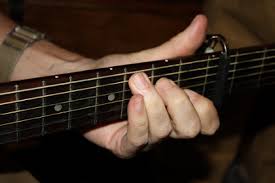
I will now briefly go over the mechanics to use the right and left hand. For this example, let’s assume that you will be using a guitar pick. You hold the pick between the thumb and index finger, with the pointed end of your pick striking the strings. There are 3 basic picking patterns to strike the strings: downstroke (toward the ground), upstroke (toward the sky), and alternate (down, then up). To fret with the left hand, make a loose fist with the knuckles bent. Place your thumb along the back of the guitar neck. Place the other 4 fingers on the front of the neck. The finger assignments for the left hand are as follows: index is 1, middle is 2, ring is 3, and pinky is 4.
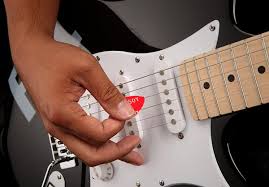
Picking

Fretting

My next blog with demonstrate several exercises that you can do to practice picking and fretting… until then, have a great musical week!
Fun with Music Scales

Welcome back, fellow musicians! I am going to talk a little about music scales. Do you remember my last blog where we talked about the three basic chord families? Well, we can approach learning scales in much the same manner. The three scales we will be discussing are

  • major scales
  • minor scales
  • dominant (7th) scales

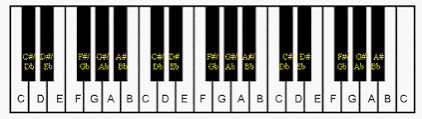
Most scales consist of at least eight notes…. hence the term ‘octave.’ So if we play a major scale, for instance, C major, we begin with the note C and end with the note C. We like to usually begin learning the C major scale first. Why, you may ask? Well, the C major scale does not have music items we call ‘sharps’ or flats.’ For you piano students, a C major scale consists of all white keys on the keyboard:

So the notes in a C major scale are, in order:

C-D-E-F-G-A-B-C

As you can see, there are eight notes in a C major scale in one octave (or any other major, minor, or dominant scale in one octave, for that matter). If you look at the keyboard picture above, you will see that there are a total of three C major scale octaves shown. That is enough scale theory for now. Ok, now without looking at a piano keyboard, do you know how many octaves of C major we can play starting from the lowest C on the keyboard to the highest C? The answer will be in next week’s blog!

Fun With Music Chords

Greetings fellow musicians! As we have talked about in the past, there are many essential chords that we will study in the course of learning music. A chord in its most basic form consists of three notes, with the name of the chord always included in its root:

For example, a C major chord has the note C as its root. If you guessed that the letter name of the chord always starts with the root letter, you are correct! So if we have a D major chord, D will be the root.

To keep chords in a basic perspective, let’s categorize chords as belonging to one of three major families (there are others, but for now we will just concentrate on three):

  • major chords
  • minor chords
  • dominant (7th) chords

Try experimenting with playing some of the chords in the workbook on page 12. Until then, happy playing!

Introduction

As you can probably tell from a first glance at my blog, I am a musician. Music has always been a passion of mine, and I am fortunate enough to be given the opportunity to perform throughout the greater Phoenix metro area on a regular basis with my music trio “Contessa Blue.” My other passions include reading and history. I am a huge fan of historical fiction, and I would easily list Wilbur Smith and Leon Uris as two of my favorite authors. As far as my own writing, I just want to improve in this area, and I welcome any and all constructive criticism and tips! If I could cite something particularly unique about myself, I would say that I actually went to kindergarten in Moscow when it was still the Soviet Union. Although I went on to study Russian, I have unfortunately forgotten most of it. Well, that’s enough about me.

Technical/Professional Writing Experience

My technical/professional writing experience is somewhat limited. I did spend a year in the writing lab of a Phoenix-area community college, where I tutored students and helped them edit their essays for courses encompassing English, science, and business.

Writing for the Web

My experience with writing for the web is also somewhat limited. I have my own music website in which I provide all of the written and graphic content. I use a site called Bandzoogle for this; they provide templates and streamline the process so that people such as myself do not have to enter HTML code.

My Personality Traits

I am:

passionate curious deadline-motivate learning-for-learning’s sake-motivated grade-motivated

My Writing Values

clarity being concise use best possible word choices to convey my ideas

My Technology Values

constantly strive to increase my knowledge of technology utilize technology to make certain tasks easier be willing to accept and to adapt to ever-changing tech advancements

Monitor Resolution

2560 X 1600 at 227 pixels per inch

My Computer

I will be using a late 2012 13-inch Macbook Pro.

My Social Media

I use Facebook to post about my upcoming music performances and recordings with which I am involved.

Computer Language Experience

I have virtually no experience with (X)HTML.

Disabilities

I am fortunate enough to be free of disabilities.

Age as a Factor

I think that a younger person is going to have an advantage due to the fact that he/she has been exposed to technology from an early age. However, anyone at any age can become tech-savvy if he/she has the drive and patience to learn!

My Knowledge of Technology

I am no “techie” by a long shot. I have learned as a result of necessity.

My Knowledge of Technical/Professional Writing

I would say that although I have not done a lot of technical/professional writing, I have be exposed to it through my NAU courses and through reading it on the web.

Social Media

Social media is a useful tool that has the advantage over print of reaching millions of people at an instant.

Other Info

I am happy to be taking this course with all of you!